Amaterasu is the Japanese sun goddess, the principal deity in the Shinto pantheon. (And yes, we know she’s the ancestor of the Emperor of Japan. So don’t wear this costume if you’re going to a party at the palace. Other than that, you should be okay.) We’re inspired by Stephanie Kao’s modern rendering above (main image), but we also love the traditional depiction of Amaterasu in a white kimono (detail from a 19th century woodcut, inset above). For our costume we’ve combined Stephanie’s rich colors with the traditional white, and added some fantasy touches.
The pieces we suggest, from left to right:
1. A cosplay costume that has absolutely nothing to do with Amaterasu, but is a great look for what we want. This is a three piece costume, and note that the white underskirt is open in the front. We suggest you tie the yellow obi/belt in the back instead of the front.

2. A shiny red skirt. This is to wear underneath, along with the tank top. Amaterasu should be shiny. She’s the sun!

3. Tomato red tank top. To match the skirt.

4. Spiky flame wig. Amaterasu is traditionally shown with sun rays extending out from her head, which is a difficult look to pull off unless you’re Cher. But you could make do with this spiky wig instead.



Brighid was one of the most prominent Irish goddesses in the pre-Christian era. Fundamentally a fire-and-sun goddess, she was also associated with springtime and fertility; with poetry, healing, and smithery; and with water, nature, and the land itself. She was so important that rather than abolish her, the Church simply incorporated her as Saint Brigid.
Modern depictions of Brighid typically show her with red hair, wearing green medieval-looking garb or an ancient tunic, and carrying a flame. The pieces we suggest, from left to right:
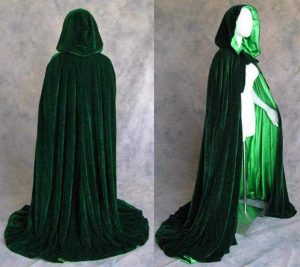
1. Green velvet cloak. This gorgeous cloak from Artemisia Designs is made of rich green velvet and lined with green satin. Very goddessy.
2. Full-length chemise in white, cream, or yellow. The early Irish leine (chemise or tunic) was pretty simple. It could be sewn with straight sleeves, like this, or it could be a sleeveless unsewn tunic pinned at the shoulders, like the Greeks wore (see #3). By the 1500s the Irish were famous for dying their leines with saffron, but it’s not clear when this preference for yellow developed.

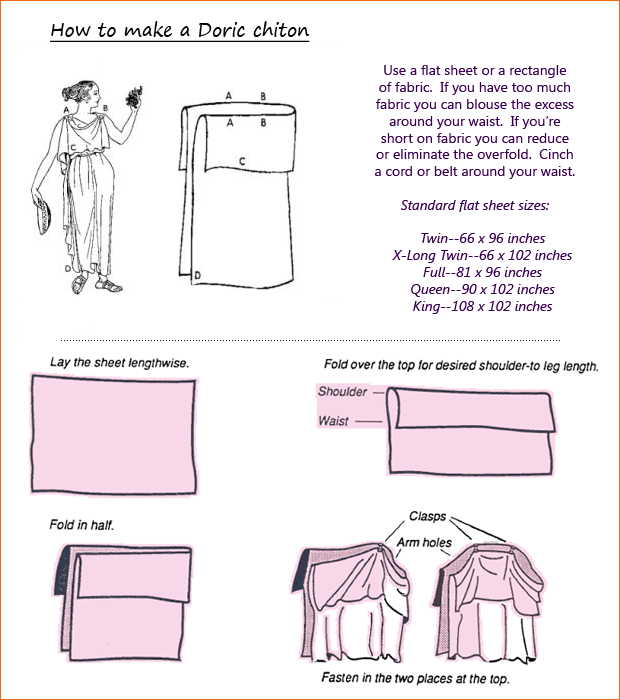
3. Alternative tunic option: a white flat sheet. If you want to go with an unsewn tunic, all you need is a sheet. In Celtic contexts the unsewn tunic is often referred to as the “bog dress,” because Iron Age versions of it have been recovered from peat bogs. It was remarkably similar to the Greek chiton; we give you instructions below on how to pin it together.

4. Long red wig.

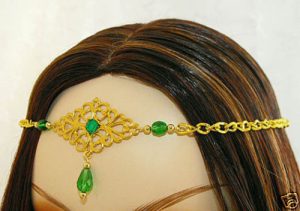
5. Celtic circlet.
6. Faux Flame 4-in-1 Torch. This is a great way to carry your sacred fire with you without accidentally burning anything up. It’s a battery-operated faux flame torch that’s convertible; you can hold it as a torch, set it on a table, hang it on the wall, or suspend it from a chain.

Here’s a short video of it in action: 4-in-1 Burning Torch Flame Light.
How to make a chiton: The simplest ancient tunic for costuming purposes is the Doric chiton, which consists of a single rectangle of fabric folded around the body. This became the jeans-and-T-shirt of the classical world, and was worn from northern Europe to the Mediterranean. All you need is a flat sheet, some safety pins, and a belt or cord. (You can get a rope belt here in white, natural, or gold.) Here are your chiton instructions: