
Mercy Otis Warren (1728-1814) was the unsung heroine of the American Revolution. As one of the intellectual leaders of the rebellion, she wrote countless pamphlets, plays, and treatises explaining the American cause. Both John Adams and Thomas Jefferson considered her a rare genius. Perhaps her most lasting contribution was the Bill of Rights: it was she who sketched out the principles that would be enshrined in the first ten amendments to the Constitution.
The portrait above right is by John Singleton Copley and was done when Mercy was about 35 years old. The sculpture on the left is by George Stuart. For the costume, you just need a colonial lady outfit—a rather nice-looking one, since Mercy was upper-class. The pieces we suggest, from left to right:
1. Colonial “Martha Washington” costume. This is ideal for Mercy or indeed any upper-class lady of the colonial period. Includes the lace-trimmed mob cap. They have this in small, medium, and large.
2. Crinoline. This will give you a nice full look down to the floor. However, you’ll also need some padding around the hips, so read on.
3. Bum roll. Like other gentlewomen of the era, Mercy wore panniers, or side hoops. That’s what made the dresses stick straight out from the hips on each side. You can buy these today from the people who do historical reenactments, but they’re rather expensive. Also, we’re not sure they would really fit under this costume. So a simpler approach is to just tie on a bum roll. This will give you some padding around the hips and in the back. You can also rig up your own bum roll/pannier arrangement with a little ingenuity and experimentation: try stuffing pillowcases with something fluffy and then strapping them onto your hips.
4. Replica of the Bill of Rights. Carry this with you and tell everyone it was your idea. Because it was.
5. Ballpoint feather pen. This is a fun prop: it looks like a colonial quill pen, but it’s really a ballpoint.


Christine de Pizan (ca.1364-1430) was a brilliant writer, poet, philosopher, and feminist. At a time when females were regarded as profoundly defective beings, Christine boldly imagined a “City of Ladies,” where women would be valued and respected. Her genius was such that she was able to support herself by writing, the first known woman in medieval Europe to do so. The illustrations above were prepared for fancy presentation copies of her manuscripts, and show the author in various scenes. On the left she is greeting some local burghers; on the right she is hard at work in her study.
As you can see, the most distinctive thing about Christine’s costume is her headdress. She wore the two-horned thing from Burgundy known as the “Attor de Gibet,” or Burgundian caul. Fortunately, you can actually buy such an item from the people who supply historical reenactment costumes.
The pieces we suggest, from left to right:
1. Late 14th century gown in royal blue. From Artemisia Designs. This is a really pretty dress, and they offer it in a full range of sizes. We also suggest a less expensive alternative dress in #2.
2. Alternate choice: Arwen dress from Holy Clothing. This isn’t trying to be an authentic medieval gown, you understand; it’s more a fantasy kind of thing. But it’s an excellent value (about $65) and looks wonderful. In fact, it looks a heck of a lot better than most of the cheapo “medieval costumes” for sale. It’s also available in a bunch of other colors and in sizes up to 5X.
3. Burgundian caul. This is the two-horned thing. That store has all their headgear in tables on one page; the Burgundian caul is about a third of the way down. You choose the veil and fabric color, and then it takes them about a week to make up your set. (If you’re handy with crafts, you can also make your own Burgundian caul with a couple of birthday party hats. Get small kiddie-sized hats and cover them with fabric, then wear them on your head like two horns. You’ll need to rig up some kind of fastening to keep them on your head, and you’ll need a piece of chiffon or something as a veil.)
4. Wimple. You can’t see it very easily from the illustrations, but Christine is also wearing a wimple, which is the white hood-like thing that we now associate with nuns. You put that on first, and then wear the Burgundian caul on top. You can get an authentic wimple from Revival Clothing. An easy, inexpensive substitute is a modern one-piece hijab. It’ll give you the same look.
5. Medieval writing set. Here’s a quill pen and parchment scroll to carry with you.
Enheduanna (ca. 2300 BCE) has been called the Shakespeare of Sumerian literature. It might be more accurate to call Shakespeare the Enheduanna of English literature.
Enheduanna is the earliest known author in the history of human civilization. She is the first author whose name has come down to us, the first author to write in the first person. Daughter of King Sargon of Akkad, she was a high priestess and poet in Ur. Her powerful hymns to the goddess Inanna, in which she narrates her own inner life and religious consciousness, became sacred texts that were treasured for centuries. She was also an important political figure; indeed, she probably played a crucial role in Sargon’s rise to power and his consolidation of the religious establishment. The famous “Enheduanna Disk” (inset in our main illustration above) actually records her likeness, showing her flanked by attendants as she presides over a temple procession.
The pieces we suggest, from left to right:
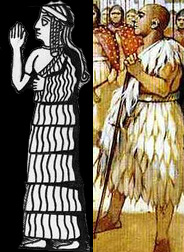
Kaunakes. On the left, a line drawing of the Enheduanna Disk. On the right, an illustration by Angus McBride of a Sumerian man wearing a kaunakes.
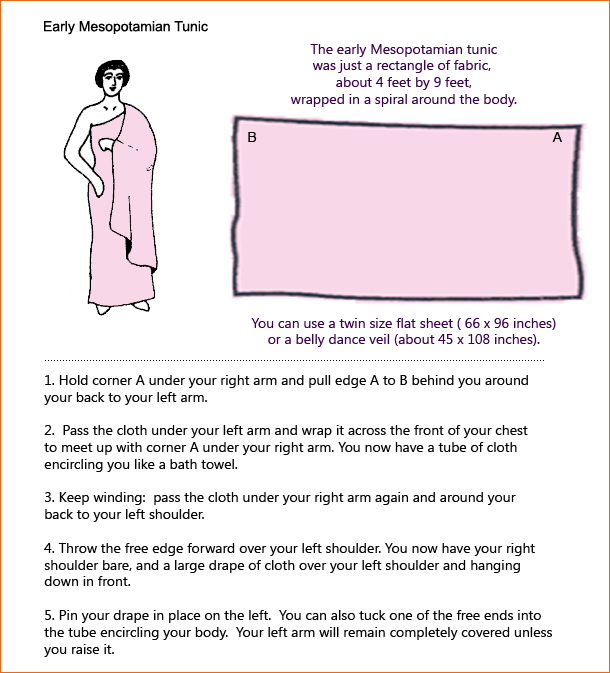
1. Twin size flannel flat sheet. The early Mesopotamian woman’s tunic was simply a rectangle of wool wrapped spirally around the body. The ideal size for the rectangle is about 48 inches by 108 inches, so a twin size sheet is a little bit off (the standard twin is 66 x 96 inches). It’s workable though; just fold down the excess. We give you instructions below on how to wrap it around your body. Red-dyed wool was the style for extremely high-status people, so we suggest the garnet sheet.
2. Optional: Three yards of 58-inch wide curly Mongolian faux fur. Most of the time Enheduanna would have worn the standard woolen tunic (#1), but on the Enheduanna Disk she’s shown wearing an archaic garment called the kaunakes. This was a cloth woven with big tufts of wool pulled out to make a super-thick shag—as if the early weavers were trying to preserve the look of sheepskin. By Enheduanna’s day this kind of cloth was probably centuries out of date and restricted purely to religious vestments. Anyway, that’s why her dress on the disk looks fluffy: she’s wearing a kaunakes. If you want to try that, get three yards of shaggy faux fur and wind it around you like a regular tunic (instructions below).
3. Braided turban headband. As high priestess, Enheduanna wore a distinctive headdress called the aga. The construction of this thing is not entirely clear from the ancient statues and reliefs: was it a cap with a rolled brim, or just a thick turban-like band around the head? The simplest approach for the costume is to go with something like this braided headband; we suggest the yellow or red. If you have long hair, wear it free flowing down your back or in long braids, which is what archaeologists think was the style for high priestesses.
4. Gold door knocker earrings. Big gold hoop earrings just like this have been found in early Mesopotamian burials.
5. Lapis lazuli necklace. The Sumerians loved jewelry of lapis lazuli, carnelian, gold, and silver. This handcrafted necklace from Afghanistan has a similar look with real lapis lazuli, silver, and reddish beads.
How to make the tunic: The early Mesopotamian tunic was just a big rectangle of cloth taken straight off the loom and wrapped around the body. All you need is a twin size sheet or a belly dance veil, plus some safety pins to help keep things in position. Here are your instructions:
Shoes: The Sumerians didn’t wear any. But that probably won’t work if you’re going out, so just wear simple flat sandals.
Makeup: The Sumerians liked to outline their eyes very heavily with kohl, so wear eyeliner top and bottom.
Illustration credits: All the paintings of Sumerian life are by Oliver Frey and appeared in the book Living in Ancient Mesopotamia, Chelsea House, New York, 2009. The Enheduanna Disk and the Sumerian jewelry are in the collection of the Penn Museum.

The Greeks considered Pythagoras the “father of philosophy.” He taught a system of natural science, mathematics, and ethics that profoundly influenced the Western canon. Ah, but who taught Pythagoras? A woman: Themistoclea. It is a curious fact that while the Greeks were hailing Pythagoras as the “father of philosophy,” they also recorded that he’d learned most of what he knew from Themistoclea, a priestess at Delphi. Well, maybe curious isn’t the word.
But back to Themistoclea. All we know is her name, her occupation (priestess at Delphi), and the approximate time she lived (6th century BCE). Presumably she was the Pythia: the Delphic priestess who was responsible for delivering the all-important oracles, possibly while in a shamanistic trance. The Greek vase painting above shows the Pythia seated on her bronze tripod, ready to deliver an oracle to the man who stands before her. The 19th century painting by John Collier is based on that vase, and on several details known from ancient Greek authors. He shows the fissure in the earth from which some sort of gas was said to escape, possibly helping to induce the Pythia’s trance state (though it didn’t affect anybody else); and he shows clearly the laurel leaves and bowl of water she held in her hands. It’s a great painting, though we’re not sure about that bare shoulder. As you’ll see below, the chiton was typically fastened on both shoulders.
The costume is simple. The Greeks wore draped tunics of dyed wool, a look which is easily replicated with sheets and safety pins. The pieces we suggest, from left to right:
1. Flat sheet in chocolate brown
2. Gold-bordered red veil. This is to drape over your head while you inhale or meditate or whatever.
3. Laurel wreath
4. Artificial laurel branch. This is to carry with you and wave around while you deliver oracles.
5. Copper offering bowl
Shoes: Simple leather sandals for going out and about, but barefoot is best for delivering oracles.
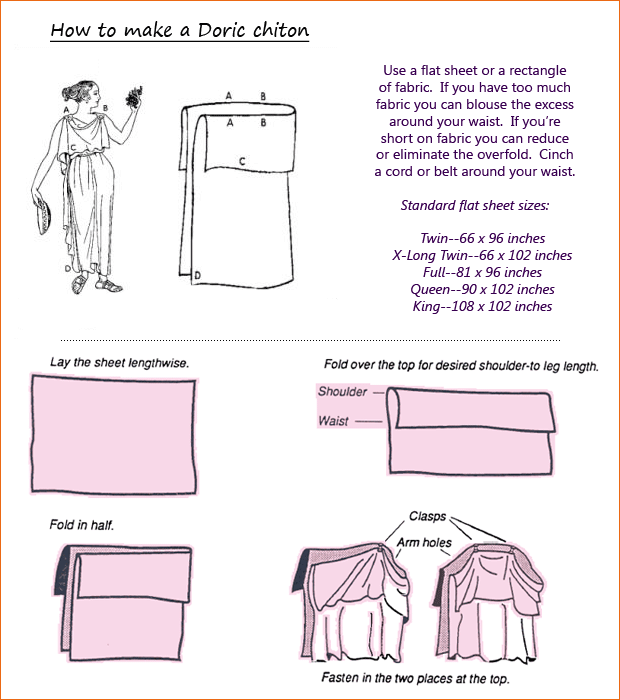
How to make the tunic: The simplest ancient tunic for costuming purposes is the Doric chiton, which consists of a single rectangle of fabric folded around the body. All you need is a flat sheet, some safety pins, and a belt or cord. (You can get a rope belt here
Sappho (ca. 620-570 BCE) was the world’s first great love poet, composing lyrics of astonishing power and immediacy. The Greeks considered her the greatest of all the lyric poets; it’s a tragedy that most of her work has been lost. The charming painting above is by Francis Coates Jones, and since nobody really knows what Sappho looked like, it’s as good a place to start as any. That’s Sappho on the right, by the way, holding the lyre.
The Greeks wore simple tunics of dyed wool, a look which is easily replicated with sheets and safety pins. Additional veils and shawls can be added for interest (like the girls on the left side of the painting). Since Sappho talked a lot about violet and saffron, we’ll use those colors. The pieces we suggest, from left to right:
1. Flat sheet in eggplant. This is for your tunic; we give you instructions below on how to pin it together. The size sheet depends on your height, but a full-size works for most people. (By the way, it’s a misconception that the Greeks wore all-white tunics. They loved to wear deep-dyed colors.)
2. Orangey-yellow chiffon veil. There’s your saffron. You can sort of swaddle this around your waist or drape it over your shoulder.
3. Small kinnor harp. The kinnor harp, also called King David’s Harp, is similar to the ancient Greek lyre. This one is small, suitable for carrying around with you as you sing love songs about Aphrodite.
Shoes: Simple leather sandals.
How to make the tunic: The simplest ancient tunic for costuming purposes is the Doric chiton, which consists of a single rectangle of fabric folded around the body. All you need is a flat sheet, some safety pins, and a belt or cord. Here are your chiton instructions:

Zenobia (240–274?) was the great Syrian queen of Palmyra who built a desert empire, conquered Egypt, and briefly gave the Romans a run for their money. She lost in the end, alas, and was paraded through Rome in chains—which is why “Zenobia in Chains” has been such a popular theme in art. The two Victorian paintings above are examples of the genre. On the left, “Queen Zenobia’s Last Look Upon Palmyra” (by Herbert Schmalz) shows her in chains with a Roman soldier waiting to lead her away. In Edward Poynter’s “Zenobia Captive,” on the right, we see the chains encircling her neck as well as her wrists. The Romans were hugely impressed with Zenobia, actually, and legend tells that Emperor Aurelian thought so highly of his royal captive that he set her free. Well, maybe. Or maybe she took her own life, as her heroine Cleopatra did. No one knows for sure.
Our costume concept is basically a 3-D version of Zenobia in Chains: Syrian-inflected Hellenistic clothing (draped tunics and layers) plus some fake chains from the costume store. We’re going to do a white linen tunic, as in the painting on the left; and a shorter tapestry over-tunic, as in the painting on the right; plus a sash. No cloak. You’ll have your hands full with the chains. The pieces we suggest:
1. White flat sheet. This is for your tunic; we give you instructions below on how to pin it together. The size sheet depends on your height, but a twin or full size works for most people.

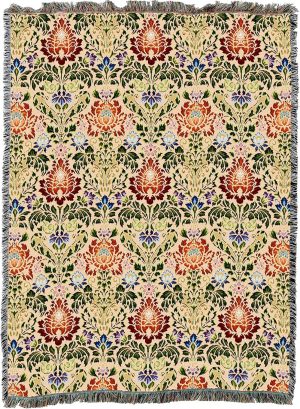
2. Acanthus pattern tapestry throw. This is for your over-tunic, which you’ll pin together and wear over the white tunic. All you need is a woven throw that looks like it could be an ancient pattern. The acanthus design in this tapestry is ideal, but you can use anything that doesn’t look too modern or pictorial (no kittens or Pittsburgh Steelers). You could even use the reverse of a throw, since the back of a tapestry just looks like multi-colored threads.
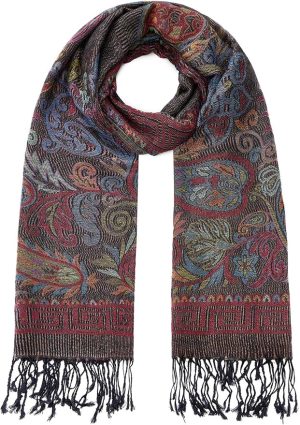
3. Paisley scarf. Use this as a belt over your tapestry tunic.
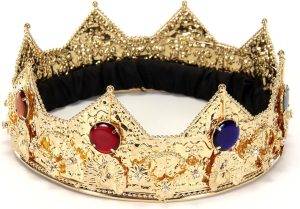
4. Gold crown. A substantial-looking metal one like this, without medieval gingerbread, is ideal.
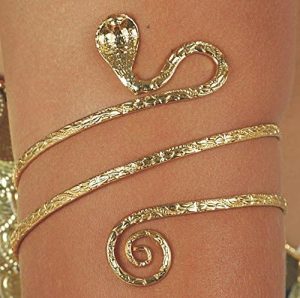
5. Gold snake armband. You can also pile on as much gold jewelry as you have: earrings, necklaces, rings.
6. Prison chains. The all-important chains!

Shoes: Simple leather sandals or boots.
How to make the tunic: The simplest ancient tunic for costuming purposes is the Doric chiton, which consists of a single rectangle of fabric folded around the body. All you need is a flat sheet, some safety pins, and a belt or cord. Here are your chiton instructions:
How to do the second tunic (the tapestry throw): You’re going to wrap this around your body and pin it on your shoulders, just as with the first tunic. However, the throw is shorter than the sheet, so you may not want to do an overfold. Just experiment to see how long you want it to hang down.
Then use your scarf as a sash to swaddle around your waist and hips. The look will be very drapey with lots of rich fabric texture.

Eleanor of Aquitaine is famed for her great patronage of the arts, and one of the finest poets at her court may have been her own sister-in-law. Marie de France (ca. 1140-1200) was a high-ranking Anglo-Norman noblewoman whose precise identity is unknown. She referred to herself briefly in her poems (“My name is Marie and I am from France”), but offered no other biographical details. Based on clues here and there, historians have long speculated that she was a half-sister to Eleanor’s husband, Henry II. Whoever she was, her fables, poems, and romances were brilliant. Not only was her work incredibly popular with her contemporaries, but it had an enormous influence on the development of French and English literature.
There are no surviving images of Marie de France, but her clothing would have been similar to what Eleanor of Aquitaine and other noble ladies of the period were wearing. (And by the way, you can easily turn this whole thing into an Eleanor of Aquitaine costume just by adding a crown.) The fashionable gown in the late 12th century was the bliaut, a dramatic side-laced dress that hugged the figure and flared out to a full skirt. Sleeves were long and bell-like. Veils were de rigueur, and Eleanor of Aquitaine is said to have introduced the barbette, a chin strap which framed the face and provided a convenient perch for securing the veil. The pieces we suggest, from left to right:
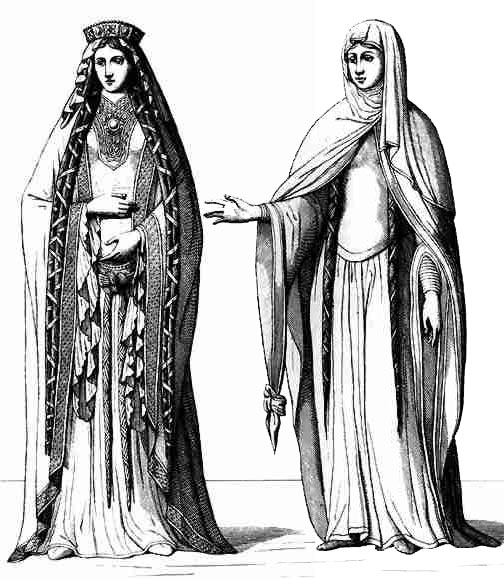
Twelfth century French noblewomen. From European Civil and Military Clothing: From the First to the Eighteenth Century by Frederick Stibbert.
1. Twelfth-century gown. This beautiful gown is made of linen and follows the authentic bliaut pattern, with side-lacing, tapestry trim, and a sash belt. It’s perfect. Unfortunately, it’s also expensive ($189). It’s even more expensive when you add a medieval chemise, which is the proper undergarment to make sure your arms and chest are covered (people didn’t show much skin back in the day). If you can afford it, then by all means go for it. But we also suggest a less expensive alternative in #2.
2. Alternate choice: Arwen dress from Holy Clothing. This isn’t trying to be an authentic medieval gown, you understand; it’s more a fantasy kind of thing. But it’s an excellent value (about $65) and looks wonderful. Also available in a bunch of other colors and in sizes up to 5X.
3. Silk oval veil. You have to wear a veil to be a proper 12th century lady, and this one is ideal. You can also get a slightly cheaper linen veil (choose oval rather than rectangular). As for how to attach the veil to your head, first we suggest you read this page for an excellent discussion of how all this headgear works. Then we suggest you get either a barbette (#4) or a wimple (#5).
4. Barbette. This is the chin strap allegedly introduced by Eleanor of Aquitaine. It fastens on top of your head, and then you pin your veil to it. (You might need to use a fillet as well.) Notice that this arrangement will not provide you with any coverage of your neck and upper chest, which is why you might want to consider a wimple (#5) instead.
5. Wimple. Instead of a barbette and fillet, you can just wear a wimple, which is the hood-like thing that we nowadays associate with nuns. It covers your head and neck, and then you pin your veil to the top. This would be an especially good style if you’re wearing the Arwen dress, which is a little too low-cut to look properly medieval. You can either tuck the wimple into the top of the dress or drape it around your shoulders.
6. Medieval writing set. This is a prop to carry with you in case you want to dash off some poems. In Old French.
Main illustration credits: The painting of Rosamund Clifford is Fair Rosamund by John William Waterhouse. (Rosamund was the favorite mistress of Henry II and a very unpopular person with Eleanor of Aquitaine.) The drawing of Eleanor is based on her tomb effigy; we don’t know the artist. The costume plate of a 12th century noblewoman looks like a Victorian thing, but we have no information about it.

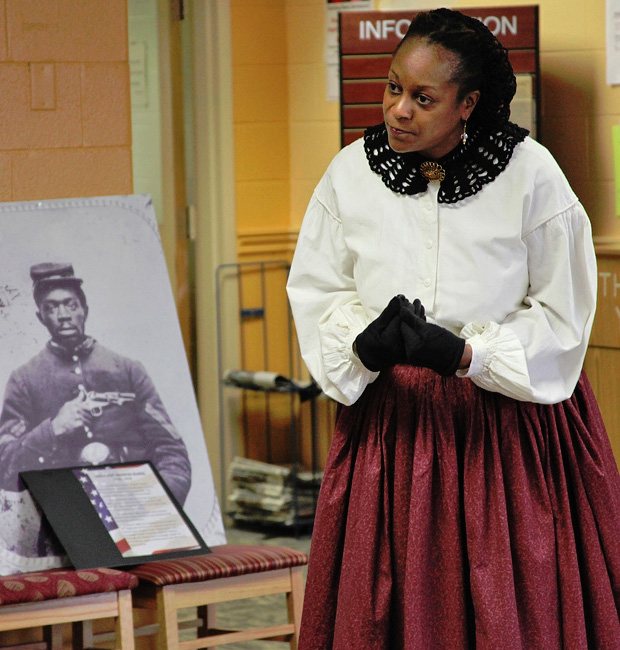
Denise Benedetto in costume as Civil War spy Mary Bowser, at Germanna Community College’s Black History Month Living History event on February 11, 2012. (Photo credit: Germanna Community College / Flickr)
Despite our name, Take Back Halloween isn’t just about Halloween. From the very beginning we’ve served as a handy year-round resource guide for do-it-yourself historical costumes, no matter what the occasion. Black History Month, Women’s History Month, community festivals, school plays, historical reenactments—we do it all. Or rather, our readers do it all, and tell us about it by email.
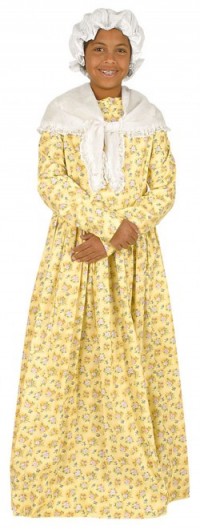
A child-size Phillis Wheatley costume from Heritage Costumes.
For Black History Month in February we always get tons of searches and queries about putting together costumes for Phillis Wheatley, Sojourner Truth, and other African American luminaries. We also get a lot of inquiries about figures in continental African history, such as the great Queen Nzinga. So I thought it might be helpful to post the links for our most popular costumes this month:
Women in African American History
Women in African History
And a note about children’s costumes…
Um, we don’t have any. Everybody asks us this, but the fact is, at this point it’s just beyond our scope to include children’s costumes. I know, I know, it’s a bummer. My apologies to all you moms out there! But there are some commercial costume places selling kids’ outfits that look like they’d work. Heritage Costumes has a Black History Month page, with costumes for Harriet Tubman, Phillis Wheatley, and Sojourner Truth. The boys’ costumes look good too. (Now if only they would add a costume for Madam Walker! Late Victorian and Edwardian costumes are hard enough to find for adults; for children they’re virtually impossible.)


Mardi Gras costumers in the Marigny neighborhood of New Orleans.
Hi, everybody! We’re back after our holiday break/anti-hacking fight-to-the-death (which we won, by the way), and raring to go. We have 17 new costumes to design, plus 2 Special Request costumes from Kickstarter backers, plus whatever else we can squeeze in. It’s going to be a big year, and we need all the time we can get.
But enough about us; what about you? Do you feel like thinking about costumes in February? Do you need a full nine-month gestation period to plan your October extravaganza? Or are you busy getting ready for Mardi Gras, like the fine folks in the picture up top?
Head over to our Facebook page and take the poll: How soon do you start planning your Halloween costume?

Some people are just born geniuses. Phillis Wheatley (1753-1784) was kidnapped from Senegal and sold into slavery at the age of seven or eight, eventually landing up with the Wheatley family of Boston. Within 16 months she had mastered English and was reading the most difficult passages in the King James Bible. Next she tackled Greek and Latin, and by age 14 was a published poet. And she was still a slave. (The Wheatleys eventually freed her.)
The illustration above left, by Scipio Moorhead, appeared on the frontispiece of Phillis’s Poems on Various Subjects; on the right is a modern version by Donna Berger. What both of these images show is a colonial woman’s basic daytime outfit: dress, apron, shawl, and cap. The pieces we suggest, from left to right:
1. Colonial outfit. This 4-piece set gives you everything you need: dress, apron, mob cap, and a shawl to tie over your shoulders in front.
2. To carry with you: Phillis Wheatley, Complete Writings.
3. Ballpoint feather pen. This is a fun prop: it looks like a colonial quill pen, but it’s really a ballpoint.
Our Kickstarter campaign is over, and you know what? WE MADE IT! And then some! Thanks to our wonderful backers and friends, we made our initial Kickstarter goal plus two stretch goals! We are so grateful for the support and incredibly excited about the costumes ahead. And the outpouring of love and good wishes towards our project has been incredibly encouraging. It’s been a joy to connect with so many like-minded souls who love history, mythology, geekiness, and the sheer fun of creating a great costume.
I hope all of you have a wonderful Thanksgiving. It’s definitely a wonderful Thanksgiving for us. If you’re one of our backers, I’ll be in touch with you after the holiday to follow up on rewards and all that good stuff. News and announcements about the Kickstarter will be posted on the Updates page. And we’ll keep posting entries in the Costume Candidates series, which you’ll be voting on later to determine our full slate of 2013 costume additions.
Thank you for helping to Take Back Halloween, and have a Happy Thanksgiving!
Backers of our Kickstarter project will get to vote on which new costumes we do for 2013. This series of posts is designed to briefly introduce the many notable women and legendary figures we’ll be considering.
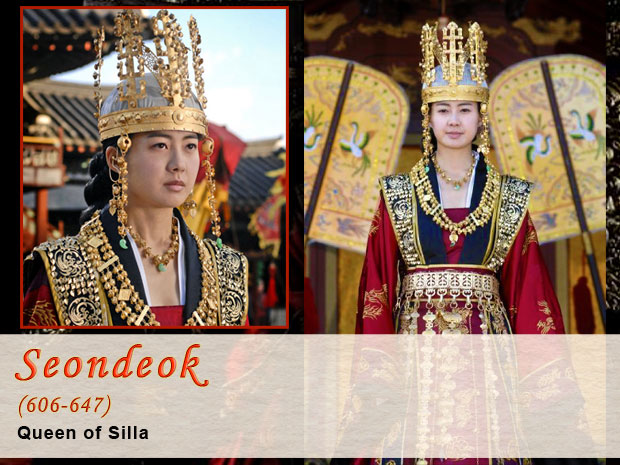
Seondeok was the greatest queen in Korean history, and the first to rule in her own right. She ascended the throne of Silla, one of the three kingdoms of ancient Korea, in 632. Her reign was by all accounts a glorious success. (The pictures above are from the 2009 TV series “The Great Queen Seondeok,” with Lee Yo-Won in the title role.) Seondeok herself is revered in Korean history for her cleverness and wisdom. Perhaps the most famous story is the one about the peonies: it is said that when Seondeok was a child of seven, her father King Jinpyeong received a box of peony seeds from the emperor of China, along with a painting of what the flowers looked like. When Seondeok saw the painting she remarked that it was a shame the beautiful flowers had such little scent. When her father asked her how she could possibly know this, Seondeok replied that the painting showed no butterflies or bees buzzing around the blossoms.
As queen, Seondeok sponsored the arts, sciences, and Buddhist scholarship. The oldest surviving astronomical observatory in the world, Cheomseongdae, was built during her reign. The period was also full of wars and rebellions, but Seondeok acquitted herself well. Despite some male resentment of “women rulers,” Seondeok held the kingdom together, and upon her death the crown passed peacefully to her chosen successor: her cousin Queen Jindeok.
Think we should add a Seondeok costume to Take Back Halloween? Make sure you join our Kickstarter project so you can vote!

